in 1519, a conquistador by the name of Hernan Cortes landed off the coasts of what is now known as Mexico with 500 soldiers, 16 horses, guns and bibles. He soon arrived at the Aztec capital city; Tenochtitlán was estimated to host a population of between 200k and 300k residents, situated on a human-made island in the middle of Lake Texcoco. The conquistador described it as the greatest city they had ever seen. Three years after the Spanish arrived, Tenochtitlan was destroyed, the Aztec and the tribes who fought for or against the Spanish found themselves under new management, one that would last for centuries to come.
While the military conquest was swift, the cultural one took centuries. Erecting cathedrals and churches on the ruins of past religious sites and holy grounds wasn’t going to be enough to evangelize the population. Preaching in local languages wasn’t a silver bullet either. What the Catholic Church did however was to blend the catholic calendar and its religious calendar with existing indigenous celebrations. All Saints' Day and All Souls’ Day, already established in the catholic tradition as days for honoring saints and praying for the souls of the departed were systematically introduced around the same time as indigenous festivities. Year after year, a blending of traditions happened, indigenous people adopted elements of the new religion while subtly retaining aspects of their own heritage; instead of giving just food to the dead, catholic crosses and images of saints were offered as well. Following independence from Spain in 1821, there was a renewed interest of pre-Columbian heritage and so The Day of the Dead, aka Día de los Muertos, became a symbol of Mexican identity and a way to reclaim cultural heritage after centuries of colonial rule, and as a cultural resistance.
Until 2015, Día de los Muertos in Mexico City consisted mainly of people going to the cemetery to be with their loved ones and setting up an ofrenda for those who had passed. Intimate, domestic, rooted in family. No floats. No crowds of thousands. No giant skeleton marionettes. All of this changed with 11 minutes of a James Bond Movie. Spectre, 2015 opens Bond moving through a spectacular Day of the Dead parade in the Historic Center of Mexico City. The parade didn't exist; it was built entirely by the film's costume department. A year later, Mexico City's government decided to make it real, launching the first official Día de los Muertos parade in 2016, explicitly modeled on the film's props and costumes, with the stated ambition of creating something on the scale of the Rio Carnival.
What most people associate with the festival now; the skull, isn’t even drawn from Mexican iconography. If the holiday was rebranded by the 007 movie, the visual was entirely borrowed. The giant skull float, the top hat, the cigar, was based on Live and Let Die (how ironic), another Bond film. The top hat is a reference to Baron Samedi, a supernatural figure from Haitian voodoo who appears as an unkillable henchman in that 1973 film. So: a Haitian spirit becomes a Bond villain in 1973. A British director borrows that image to dress a fictional Mexican parade in 2015. Mexico City builds the real thing in 2016, Haitian skull included. Three displacements are now an annual tradition, and so steeped in iconography that most people assume it goes back to generations.
“Our grandparents never did this” is a sentence we always hear whenever something new enters tradition. It sounds like a Tollman disguised as a historical observation; a boundary to draw the line between what is acceptable and what is not. The reality is that that boundary was and is always moving; culture is always changing, constantly being modified by human intervention and personal choices, consciously or unconsciously. It is not a new phenomenon brought by Globalization™, it is one of the oldest conditions of human society. One of the engines of this change is the movement of ideas, technologies, customs, and beliefs. It can be through the introduction of new people via migration or through food via trade; it happened before sometimes through mere proximity, and sometimes from pilgrimage. And by definition, a tradition must start somewhere. Tomatoes, one of the main ingredients in many Italian dishes, was introduced to Europe in the 16th century via the Colombian exchange. Most of what we consider Italian traditional food is more recent than what people think. Poutine, the national dish of Quebec, is only 70 years old. Even the Moroccan Mint Tea ® is new relatively speaking. Tea was introduced in the 18th century, sugar and tea became a symbol of power and prestige, and it was even boycotted by religious figures or ordered people not to drink it, deeming it Haram. Imagine, Mint tea, Haram. The religious argument against something new is not evidence of that thing's wrongness. It is evidence of discomfort with change dressed in the language of scripture. History has a consistent track record on this; the things declared haram, sinful, corrupting, or inauthentic in one generation become the cherished traditions of the next.
So, who decides? Who looks at a practice and says, “this is the real thing, this is where the tradition begins”? There is always someone drawing the line, and the line is always drawn in their favor. When a society starts to change fast enough that people need something to hold onto, when the feeling of permanence becomes the point and the age beside it, the person who controls it gains something valuable. They gain the right to say what belongs inside it and what doesn't. They gain a tollman's power: you may pass, you may not. This version is authentic, this is corruption. Hobsbawm called these invented traditions.
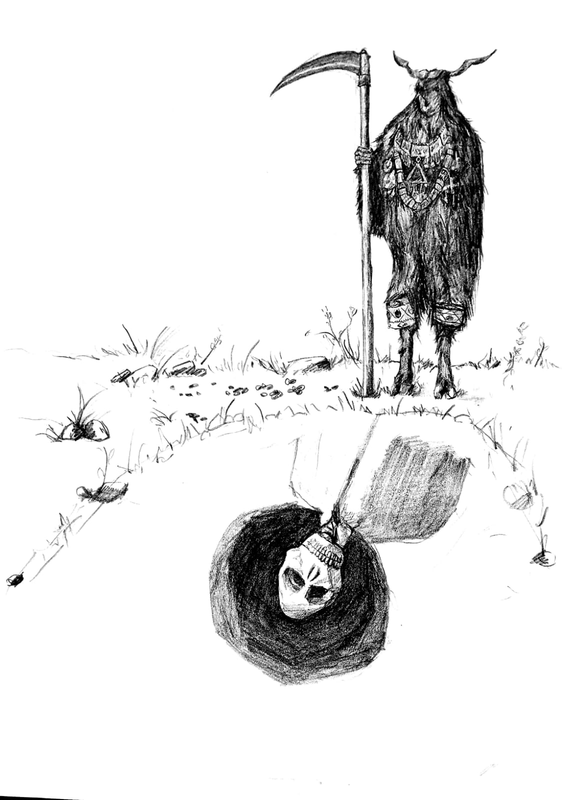
In the days following Eid al-Adha, a unique sight unfolds in the streets of Agadir, Dcheira, Inezgane, and other parts of the Souss and Anti-Atlas regions in Morocco. Men, mostly adolescents and young adults, parade through the streets, their bodies adorned with sheep or goatskin, heads crowned with horns, faces painted or masked. Bilmawen, better known by its Arabic name, Boujloud; the one with the skins, is a folk tradition with roots that stretch back to pre-Islamic times in Morocco. Historians and anthropologists disagree on where exactly the ritual began; some argue it developed from pre-Islamic Amazigh ceremonies connected to seasonal change, fertility, and renewal. Others have linked it to the Roman myths of Lupercus and Saturnalia. But Moroccan anthropologist Abdellah Hammoudi suggests its symbolism is connected to the sacrifice of Eid al-Adha itself. He argues the Islamic holiday may have adopted an older Amazigh festival that began with a sacrifice, that the new festival might be seen as a continuation of the old, possibly disguised by Christian and then Islamic traditions. Morocco adopted Arabic and Islam over a period of centuries. The Amazigh people who had lived across North Africa long before either arrived did not disappear. The languages survived. Their practices survived partially. And Bilmawen, whatever its precise origin, survived and folded into the calendar of Eid al-Adha in the same way Día de los Muertos folded into All Saints' Day, I would argue. The skin stayed.
Nowadays, whenever the carnival occurs, once pictures of the men wearing the skins, horns, and makeup hit the web, a cascade of critiques follow; it almost seems that this is what will become a tradition. The first critique comes from those who invoke religion to draw the line. The argument is straightforward: Bilmawen predates Islam, therefore it does not belong in a Muslim society. It is pagan residue, a leftover, something that should have disappeared when the faith arrived and didn't, and whose continued existence is an embarrassment at best and a transgression at worst.
What this argument cannot explain is why Bilmawen survived in the first place. The tradition attached itself to Eid al-Adha and persisted for centuries within a Muslim society without being eradicated. That merger was not forced. Nobody decreed that the skins would be worn the day after the sacrifice. It happened because the people who practiced one found a way to hold onto the other. In my opinion, it’s the same negotiation, the same camouflage, the same instinct that hid Día de los Muertos inside the catholic calendar in Mexico. Which makes the current argument strange. Centuries of Muslim Moroccans practiced Bilmawen without apparent contradiction. It is only now, in the age of the fatwa shared on WhatsApp, that the contradiction has become intolerable.
The second critique comes from a different place entirely and is in some ways harder to dismiss because it sounds like it is coming from inside. These are not people who want Bilmawen gone; they want it preserved, which is to say, they want it frozen. The argument is that the new carnival form, with its contact lenses and 3D makeup and elaborate prosthetics, has drained the tradition of whatever made it real. The original Bilmawen was raw; it was the actual skin of the actual animal sacrificed that morning, still warm, worn by someone who had grown up watching their father wear it. What is happening now is costumes, it is performance. It is young people who saw something on social media and wanted to participate in an aesthetic. It's almost halloween-esque.
However, the young man in Agadir who spent a month building his costume, sourcing the skins from the weekly souk, coordinating with his group months in advance, he is not a tourist in his own tradition. He is doing what every generation before him did: taking what he inherited and making it his. The makeup might be new, but the instinct is not. Every element of Bilmawen that the purist now considers authentic was itself new at some point. The drums were added. The specific choreography evolved. There was no original, perfect, untouched version waiting to be protected. There was only the living thing, moving forward, absorbing what each generation brought to it.
The authenticity argument is always made by the generation that arrived just before the change. It is a way of saying: what I inherited is real, what comes after me is corruption. It is understandable. It is also structurally the same argument that has been used against Bilmawen itself, and neither is wearing the skin.
This is not a new pattern. In 2003, a satanic panic led to the arrest of members of Moroccan metal bands for allegedly practicing Satanism. The music was foreign, the clothes were wrong, the hair was too long. When that generation was released and the scene survived, the argument simply moved on to the next thing.
A few years later, it was the alphabet. For decades, Islamists and pan-Arabists questioned the need to constitutionalize Tamazight, include it in school curricula, or display it on official buildings, and particularly in its original Tifinagh script. Behind these disagreements over the alphabet lurked deep ideological issues related to how each group conceived of Moroccan identity. The PJD's secretary general dismissed Tifinagh as "Chinese script."
The critique of Bilmawen's new form follows the same logic. When it was raw and local, it was pagan. Now that it is elaborate and visible, it is fake and dangerous.
This is what the Mexico City parade and Bilmawen have in common. Not their history, not their geography, not their religion. What they share is the experience of being told, from multiple directions simultaneously, that they are doing their own tradition wrong. The parade is too commercial, too invented, too Hollywood. Bilmawen is too pagan, too new, too elaborate. The target is always the current form. The argument is always that something realer existed before. But the people building the marionettes did not ask for permission, the people wearing the skin did not ask for permission. They inherited something, changed it, and kept going. That is not corruption. That is what living traditions do. The ones that stop moving are not preserved. They are just dead.
Tea was haram, then sugar and mint were added.